Millican, Confederate States of America
By Jesse Flecha
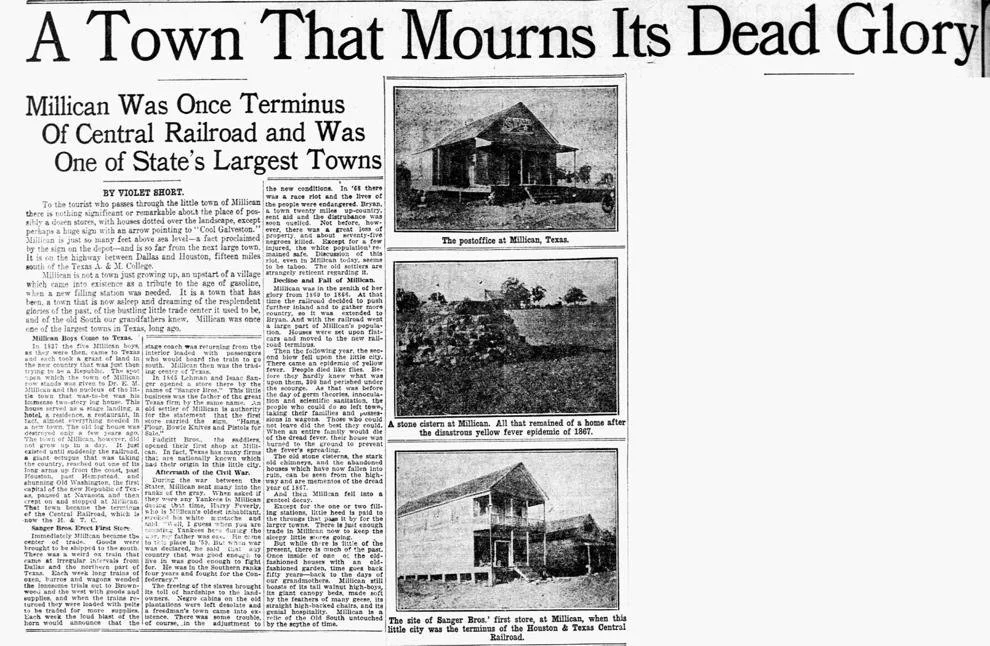
The small town of Millican, Texas, is a perfect embodiment of the American epoch that was the Civil War and Reconstruction. It encapsulates both halves of the national conflict and shows that Texas was not a far-off land removed from the fight over slavery, but was deeply ingrained in the institution and the struggle over a new meaning of freedom and liberty in the United States. Millican also offers insight into the power of the railroad in the mid-nineteenth century and what that meant for a local community. The high point of Millican’s existence was during the Civil War years. Founded by Robert Millican in the 1820s, the town served as little more than a stagecoach stop until 1859, when the Houston and Texas Central Railway built a station in Millican. Quickly, the town flourished, as it was the northernmost railroad terminus in Texas.
Leading up to the Civil War, Brazos County proved a hotbed for secessionist sentiment, and Millican was the county’s most important town. Slavery was firmly established in Brazos County and was rapidly growing by 1860. In 1850, Brazos County produced only 142 bales of cotton, but by 1860, it had increased to 2,269 bales, mostly off the backs of enslaved labor, which made up 40% of the county’s population. As the cotton states began seceding in late 1860 and 1861, Texas was the only one to hold a referendum before its secession. This gives us great insight into the minds of the local populace at the time, who voted overwhelmingly to secede, 215-44. Millican and Brazos County matched their words with actions and fought fiercely for the cause of slavery, which General Grant called “ one of the worst for which a people ever fought, and one for which there was the least excuse.”
In 1861, Millican’s importance as a railroad hub was magnified by the outbreak of the war. It allowed the Confederacy to send supplies to the Red River and frontier settlements to the west, and to bypass the Union blockade by shipping cotton south to Brownsville and Matamoros, Mexico. Confederate troops came to Camp Speight, near Millican, by rail, trained, and formed regiments that fought across the Confederacy. These included the 21st and 25th Texas Cavalry, which fought in the Red River Campaign, and the 10th Texas Infantry, which fought in the Atlanta Campaign and was ultimately decimated at the Battle of Franklin under the command of John Bell Hood.
Millican’s importance in Texas during the Civil War cannot be understated; it was a vital rail hub and recruitment center. But, like the Confederacy itself, its existence was just a flash in the pan. By 1866, the railway moved north to a new town called Bryan, leaving Millican behind. Many white residents followed the railroad and relocated to Bryan, and by 1868, Millican had a population of around 1,200, who were predominantly African American. Still, white supremacy continued to grip the South following the Civil War, and as we’ll see at our next stop, white Southerners often blamed Black Americans for their loss of power and resorted to horrific violence in an attempt to regain it.
Sources:
https://liberalarts.tamu.edu/blog/millican-massacre-historical-marker/
https://www.hmdb.org/m.asp?m=190131
https://www.tshaonline.org/handbook/entries/brazos-county
https://www.tshaonline.org/handbook/entries/twenty-first-texas-cavalry
https://www.tshaonline.org/handbook/entries/tenth-texas-infantry
https://millican.omeka.net/about
https://www.nps.gov/articles/lessons-from-the-personal-memoirs-of-u-s-grant.htm
https://history.brazoscountytx.gov/historic_marker/millican-c-s-a/